
The Metallic Stag Beetle
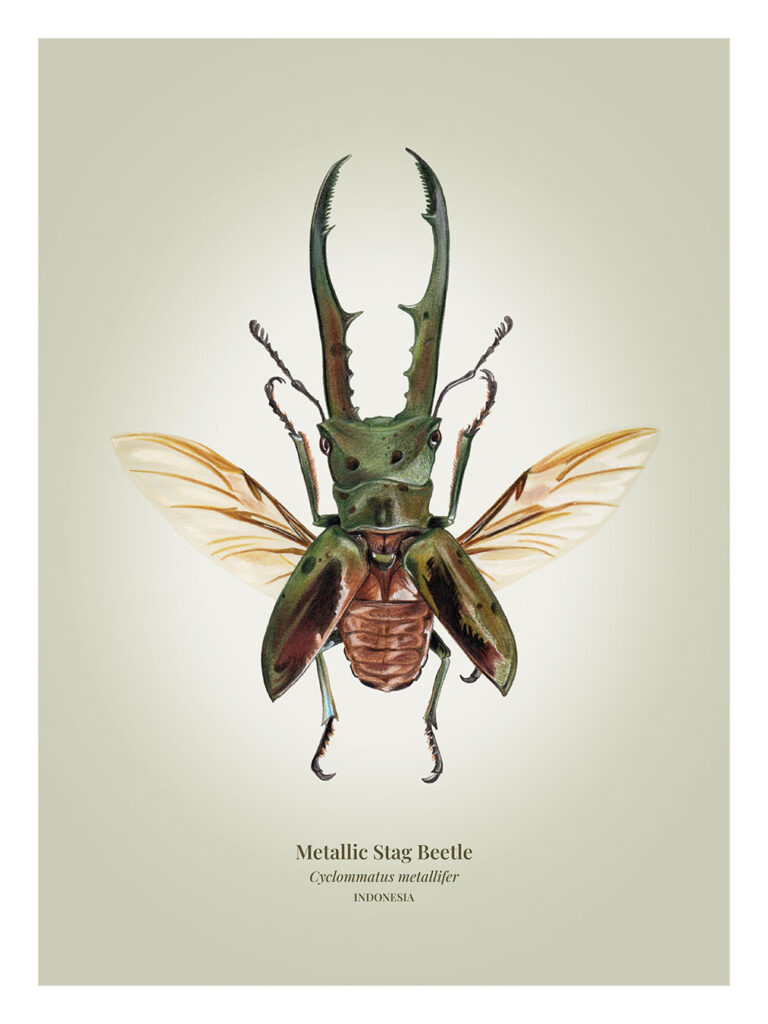
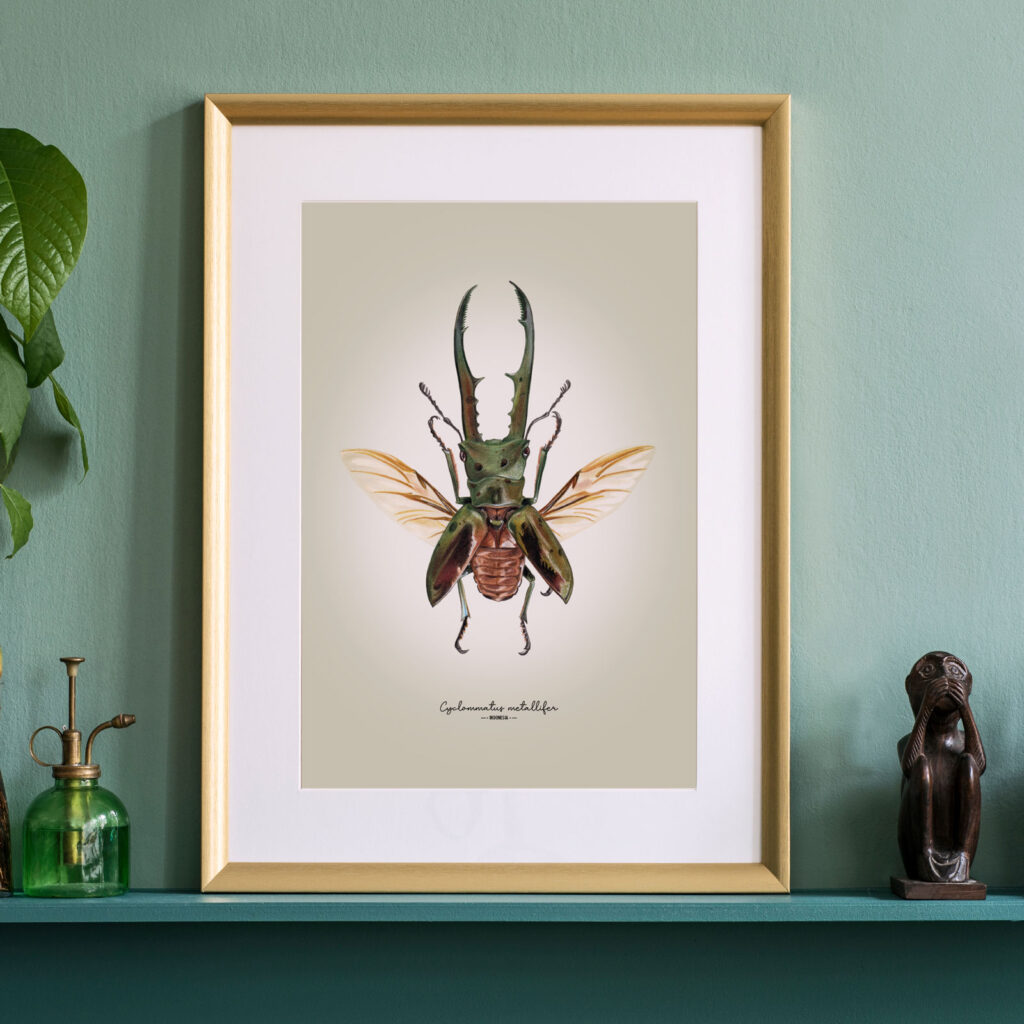
Cyclommatus metallifer
Indonesia · Family Lucanidae · First described by Boisduval, 1835
The Metallic Stag Beetle is one of those species where the closer you look, the more questions you have. From its shimmering exoskeleton to the improbable weight of its mandibles, it’s a beetle that rewards attention.
Where it comes from
Cyclommatus metallifer is found across Indonesia, primarily on the islands of Sulawesi and the Maluku Archipelago, where it inhabits tropical and subtropical rainforest. It’s a beetle tied to dense, humid forest, the kind of place where decaying hardwood is plentiful and the canopy keeps the air thick and warm year-round. The species was first formally described in 1835 by the French naturalist Jean Baptiste Boisduval, based on early specimens likely originating from Sulawesi. Since then, taxonomists have identified six subspecies, each associated with a specific island or island group. Subtle variations in colour, mandible structure, and size that tell a quiet story about geographic isolation over millennia.
That colour
The name metallifer, Latin for “metal-bearing”, doesn’t oversell it. The beetle’s shimmering surface can appear golden-green, bronze, or polished silver depending on the light, and it isn’t produced by pigment at all. Instead, the exoskeleton uses structural coloration, a microscopic layering that bends and reflects light in a way similar to what you see in peacock feathers or morpho butterflies. In practice, this means the beetle looks different depending on the angle you hold it, the quality of light, and even the time of day. It’s the kind of detail that a photograph can gesture at but rarely fully captures. It’s part of what drew me to study this species closely.
Bring this beetle home
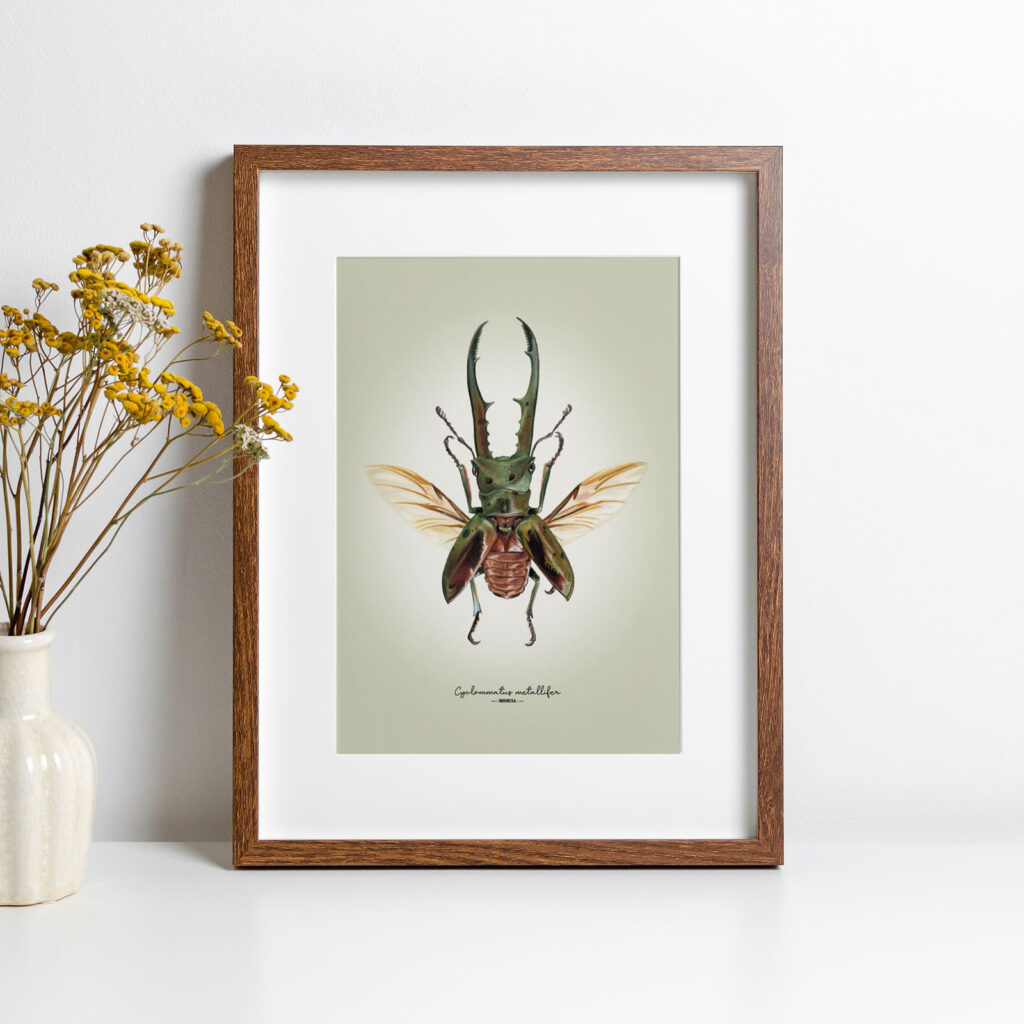
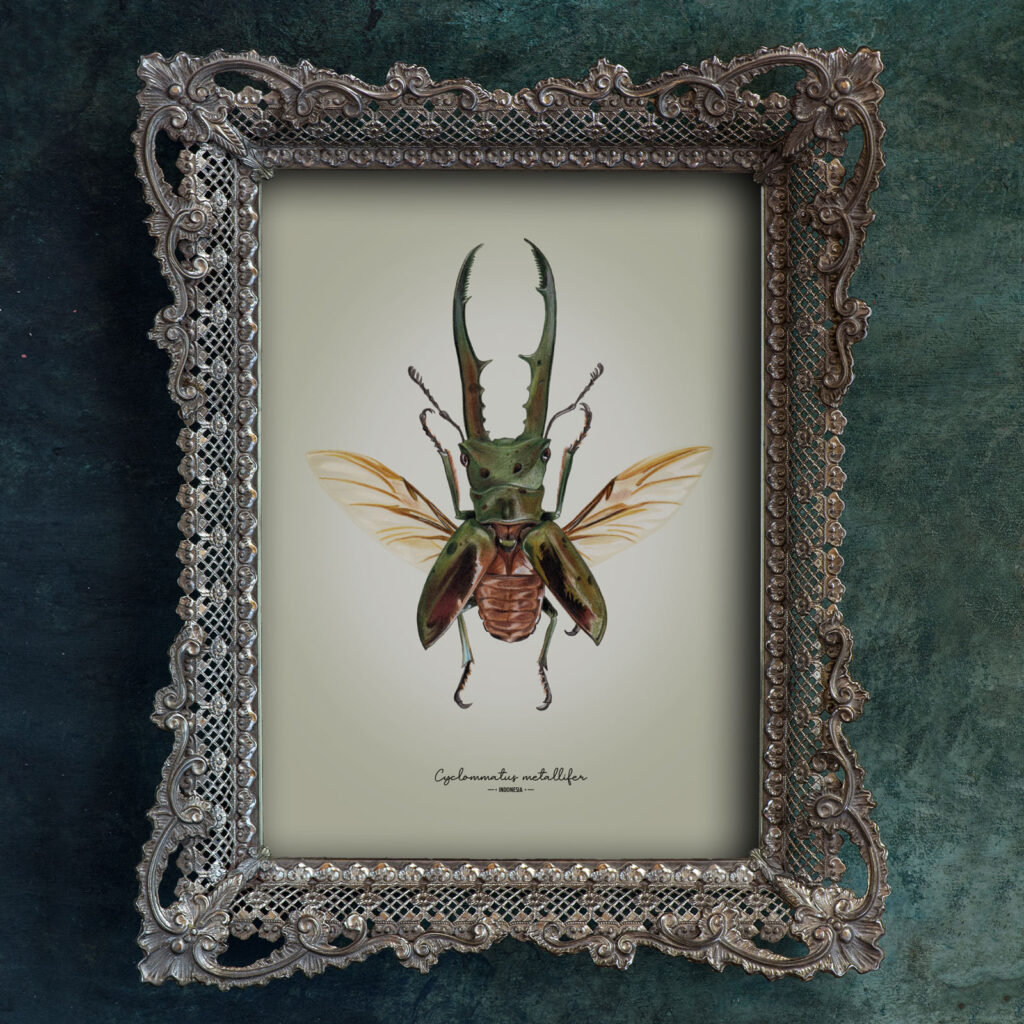
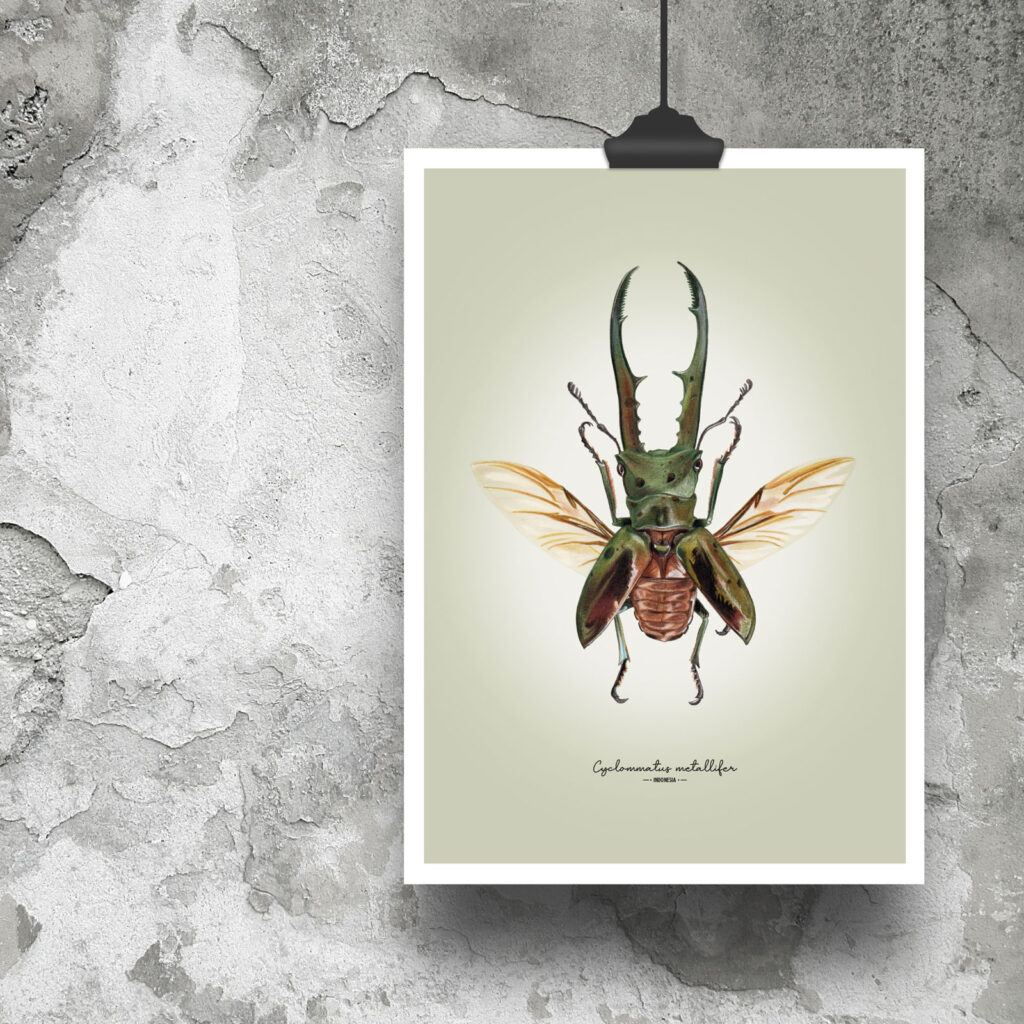
This illustration is available as a fine art print — made to be looked at up close, just like the real thing.
The mandibles
The males of this species are defined by their mandibles. In larger individuals, the mandibles can exceed the length of the body itself, a result of juvenile hormone regulation during the larval stage, with final size largely determined by the quality of nutrition the larva receives. They are extravagant, almost architectural. But they come at a cost.
The enlarged mandibles reduce the male’s ability to run, make flight harder, and require significantly larger head muscles to compensate for the weakened bite force they cause. Every millimetre of that jaw is paid for somewhere else. It’s a vivid example of how sexual selection can push a species toward something that looks almost impractical. And yet here it is, persisting across six island populations.
Behaviour & Life Cycle
Adult C. metallifer feed primarily on tree sap, which they access by scratching bark with their mandibles, often gathering at sap flows where males compete for access and for mates. These feeding sites become arenas. Males will guard both the sap source and the female, chasing away rivals in confrontations that can involve grappling, lifting, and pushing. The adult lifespan is relatively short, a few months at most, which gives a certain intensity to everything they do.
Mating is followed by egg-laying in decaying wood, where the larva will spend the majority of its life. The larval stage is the longest part of the beetle’s existence by far. Females take around four to six months to develop through to pupation, while males take considerably longer, up to a year, largely because of the additional resources required to grow those mandibles. The final size of the adult is determined almost entirely by how well the larva was fed. A well-nourished male larva produces a larger adult with longer mandibles. Nutrition, not genetics, is the deciding factor for absolute size.
The pupal stage lasts roughly a month before the adult emerges. Once above ground, the beetle’s sole purpose shifts to reproduction. It no longer grows, and it eats only to sustain itself long enough to mate. Everything the larva spent months building is spent in a matter of weeks.
Where it started
This was the first beetle specimen I ever bought. It arrived already framed, and I remember just sitting with it, turning it in the light, trying to make sense of what I was actually looking at. I’d seen photographs, but nothing quite prepares you for the real thing at arm’s length. The scale of the mandibles, the way the colour shifts as you move it, the sheer precision of every part of it. I couldn’t put it down.
It was this beetle that made me want to illustrate them. Not insects in general, not nature broadly. This specific creature, sitting in its frame, refusing to be looked away from. Everything that followed started here.
The Illustration
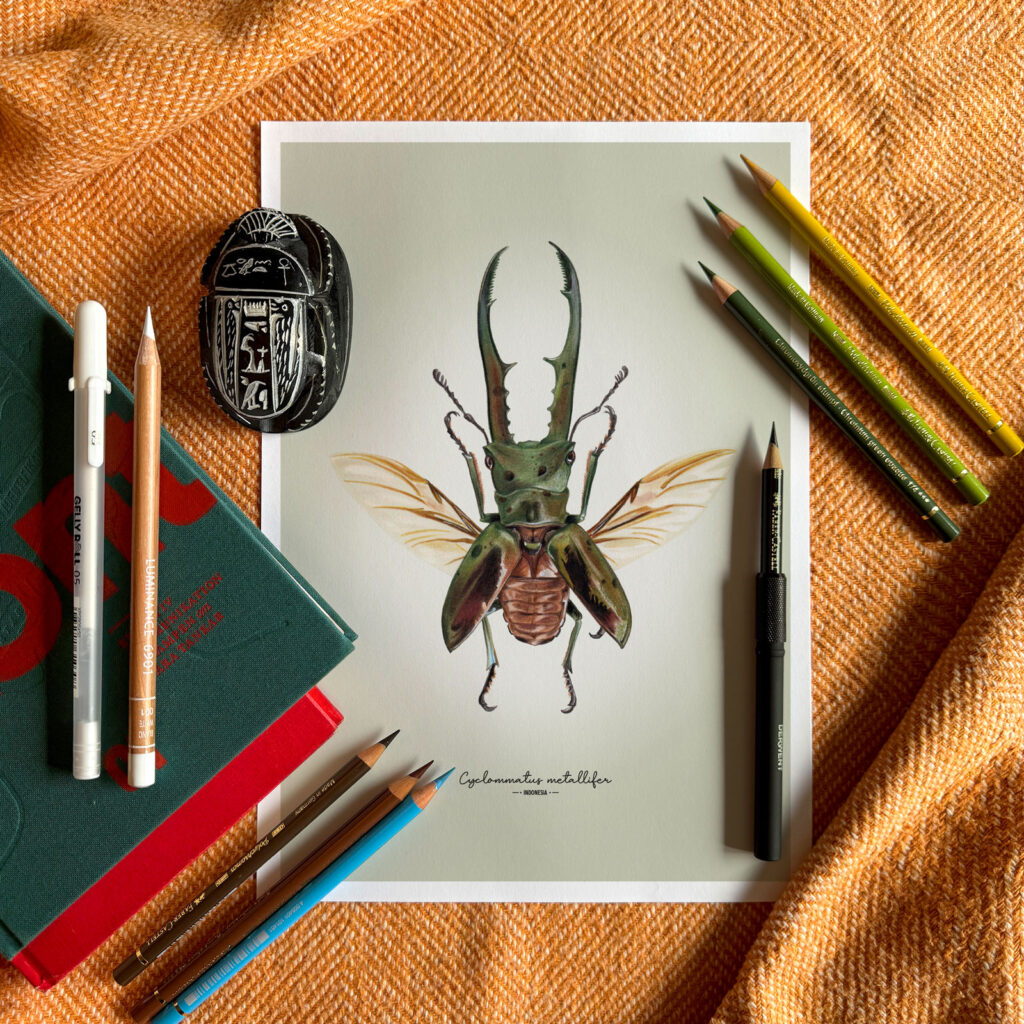
This piece was drawn using Faber-Castell Polychromos pencils on Fabriano Artistico 300g hot pressed cotton paper, a combination that rewards slow, deliberate work. The hot pressed surface is smooth enough to hold fine detail, and with a subject like Cyclommatus metallifer, detail is everything.
The metallic sheen was the central challenge. Structural colour doesn’t behave like a flat tone. It shifts, it reflects, it almost seems to move. Getting that onto paper meant working in layers, observing how the light fell across the exoskeleton from different angles, and making a lot of small decisions about what to include and what to let the eye fill in.
The original is A4. Prints are available in both A4 and A3 through my Etsy store.